
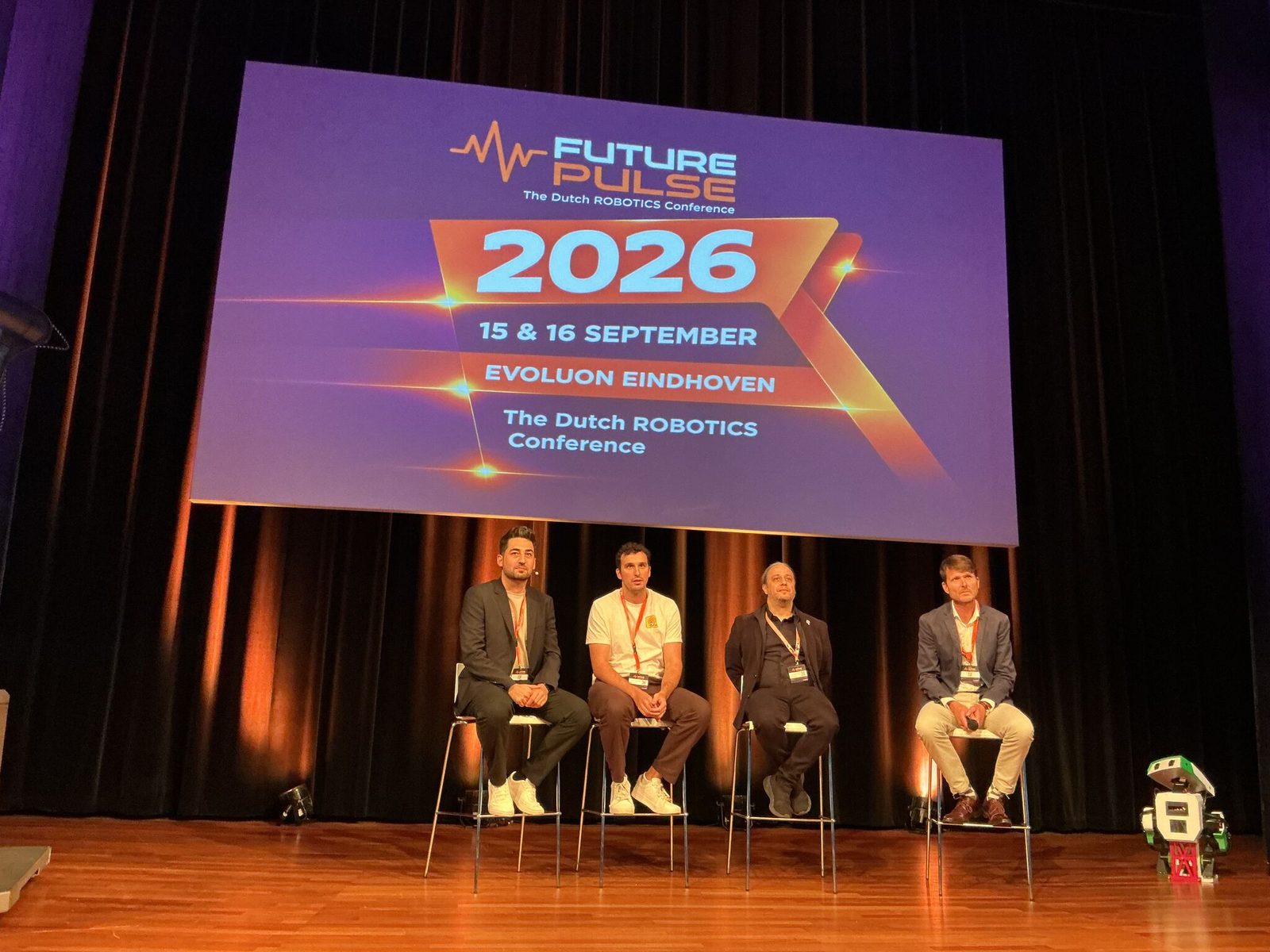
This interview was first published by Businesswise.nl. Republished in English with thanks.
Humanoid robots stand on the threshold of a new phase, moving from demonstrations and trials into actual deployment in industry. What is required for that to happen, and what role do data, safety and European standards play?
Lars-Fredrik Forberg follows the field closely. The Norwegian is co-founder of the B2B marketplace Kinetic Blocks and of Humanoid.guide, which carries out market research in the robotics sector.
From demonstration to deployment
The global market for humanoid robots is still in its infancy. Forberg's research indicates that only a few hundred humanoids worldwide are fully operational in companies.
Putting a robot straight to work is not at all simple.
"If you buy a robot today and want to put it to work tomorrow, you have to train it for weeks. They will improve, of course, but at this moment it takes time, because you have to be certain the robot is safe, that it will not injure anyone, and that it understands your specific task."
Although robots are trained on large volumes of video material, they do not automatically know every specific task or working environment.
"So the question is: how can it come to know your task and your industry? It can, but right now that takes a very long time. You have to start somewhere."
Even so, Forberg expects deployment to grow quickly.
"Within a few years we will have robots in factories doing work that people do today."
He points to Renault, which in his view intends to scale up its use of humanoid robots.
"Renault will have 350 humanoids by the end of next year. That is a large number, so let us call it 100. But it is going to grow by a factor of ten a year."
Safety as a European responsibility
Deployment at scale demands more than robots that can carry out their tasks. Safety, cybersecurity and fitness for specific working environments are equally important conditions.
Forberg notes how fast the technology is moving.
"Unitree's G1+ can already do far more than the G1 version."
At the same time, he sees a role for Europe in testing and certifying safety requirements.
"Germany is very strong at testing and certifying safety requirements. Europe has strict requirements, and we will educate the manufacturers on how to build robots safely."
A global contest
As the technology develops, competition between Europe, China and the United States intensifies. Forberg expects China to take a leading position in the development of humanoid robots. For Europe he sees opportunities in other parts of the market.
"I think we are going to see enormous competition. My last slide showed the future layers of the industry, and China will win that race. The United States will have some high-end robots in industry. But on the rest we can compete on deployment, on the data layer and on the secondary market."
In Forberg's view Europe is not late, but is taking its own approach.
"The race for the humanoid industry has only just begun, and we are not behind in any way. In my opinion we are simply taking our time and doing the right things: putting safeguards and standards in place."
What the sector will look like in ten years remains uncertain. Forberg does expect companies to disappear or be acquired. He draws a comparison with the electric vehicle market.
"We had 500 brand manufacturers, the OEMs, and now we have about fifteen left. The same applies to robotics. There will be enormous consolidation. Some of the large players will be acquired or go bankrupt, and that much is certain."
From frontier AI to physical AI
The development of artificial intelligence also shapes how humanoid robots evolve. Forberg draws a comparison with frontier AI models, meaning advanced systems that can solve complex problems while also carrying risks.
"Smart robots get compared to frontier AI models, models that can break through safeguards but can also produce remarkable innovations and solve difficult mathematical problems. Those models, which exist for the best and the worst of humanity, come first. After that it will filter down to humanoids."
What such models make possible may eventually carry over to robots operating in the physical world. Forberg expects humanoid robots to be capable of far more in future than they are today.
"In future, humanoids will be able to do far more than a human can. That will become a new discussion, and it is tied to the physical form, the embodiment. You will get super robots that can jump higher and do all kinds of industrial work, remarkable work that no human could ever do, which is a good thing. But of course you will also get combat robots that kill people or other robots far more efficiently than people can."
The debate about AI will therefore increasingly be about physical robots as well.
"But right now everyone is simply racing to build better models and to work out how to crack the code of physical AI. So it is not yet as large a concern as pure AI, but it is coming."
Regulation, ESG and fair trade
Alongside the technology sits the question of how the sector will be regulated. In Forberg's view, legislation cannot cover everything, because companies also conduct research behind closed doors.
"You can only regulate what is on the market. You cannot regulate what happens behind a company's gates, in their laboratories. New research always takes place, regardless of the rules."
Beyond regulation he sees a role for policy on environmental, social and governance matters, brought together under the heading of ESG.
"Of course you have to introduce regulation, but alongside that we need ESG policy. We need to move towards a social robot with a value grounded in fair trade. That is just as important as regulation."
The market itself can also help enforce such conditions, Forberg argues.
"The market will enforce these kinds of corrective mechanisms. I think I am an optimist on that."
How the robotics industry develops over the coming years remains an open question. Forberg, at least, is looking ahead.
"It is now a question of timing."