
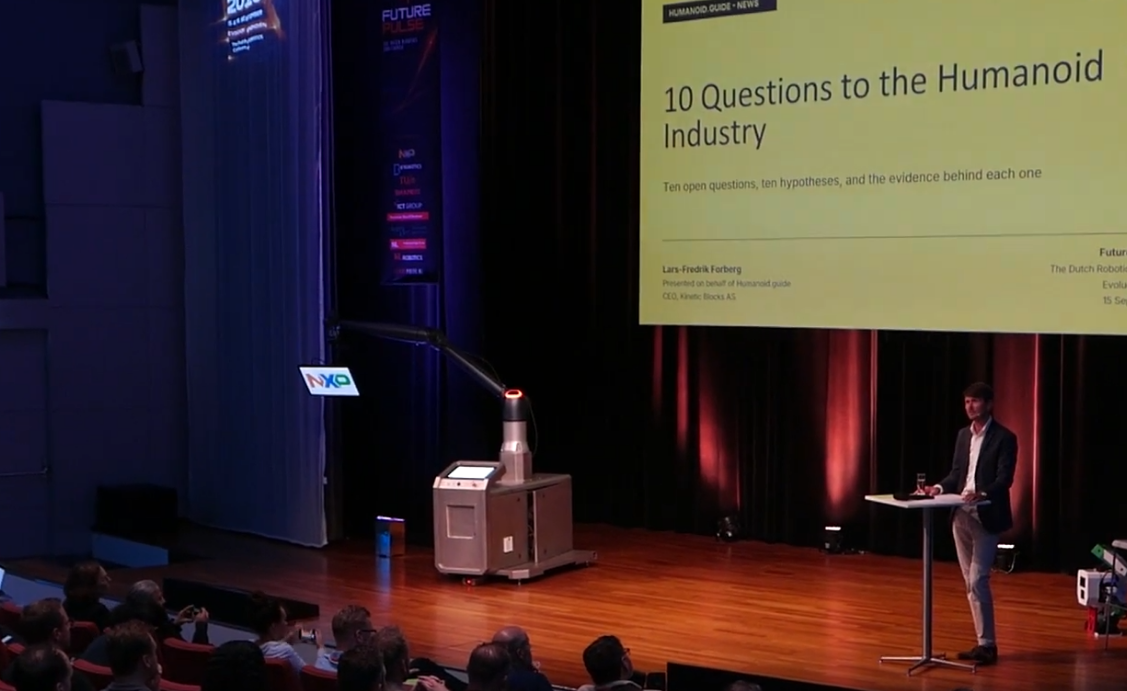
In this interview with Rocking Robots at Future Pulse in Eindhoven, our CEO Lars-Fredrik Forberg explains how Europe may use its strengths and capabilities to introduce new safety standards and robot benchmarks, and so deploy robots both safely and in good time. He also gives practical tips on how to get started with robotics.
The usual account of the humanoid race has Europe some way behind. China builds the machines and builds them cheaply, the United States builds the frontier models, and Europe writes the rules that make both harder to deploy. Forberg's argument runs the other way, and the order of the steps in it matters.
"So this is just the beginning of a new industry also for Europe. And if we are wise, we can benefit from our competitive advantage when it comes to regulations to deploy robots in a safe manner, to harvest the data and use the data to build even better applications and a society for people. So Europe will be in the forefront also in the future."
Read that as a sequence rather than a sentiment. Regulation permits safe deployment. Deployment produces data. Data produces better applications, which in turn justify the next deployment. A region with strict requirements and the institutions to certify against them is not the slowest to start. It is the one that can put machines next to people soonest, and everything downstream depends on that.
Standards, and the benchmarks that go with them
Standards decide what is permitted. Benchmarks decide what is comparable, and the second is the part still missing.
The standards work is further along than most people outside the standards bodies realise. A draft product standard covering dynamically stable industrial mobile robots is in development on a three year project that began in July 2025 and releases in mid-2028, intended to be harmonised across the EU and the United States and therefore legally binding in both. Any country may appoint experts to the working group, which is a narrow window worth using.
The benchmark work is where Europe's testing institutions are already ahead. Fraunhofer IPA now runs a sixty-six test framework covering capability, functional safety, cybersecurity, energy efficiency and cleanliness, applied across machines from Unitree, Dobot, Agibot and Neura. The early results are unflattering to the hardware: collision force testing against ISO norms puts almost every result in the yellow to red range, and the fifty kilogram Unitree G1 is not permitted for power and force limited operation under EU norms at all.
That is not a brake on European robotics. It is the beginning of the measurement a buyer will eventually purchase against, and a manufacturer cannot sell into a regulated environment without it.
The layer forming underneath the manufacturers
Asked what has to happen in practice, Forberg's answer was about learning rather than buying.
"We need to continue deploying humanoids into the industry, European industry, to learn, and not only to learn how they work but also how to train them and how they can work alongside humans."
He expects that work to create a category of company that barely exists yet.
"So we will now see a new layer of players in the industry, namely the integrators that buy humanoids from OEM manufacturers overseas and then deploy them in the European industry."
This separates two questions that often get merged. Who manufactures the machines is largely settled. Who deploys them, trains them for a particular factory, maintains them and holds the record of how they performed is not settled at all, and it is being decided closest to the customer. We have seen the same thing from our side of the market: the integrators and fleet operators running machines on behalf of others have turned out to be among the most willing holders of usable data, because for them the data is a by-product of a service business rather than the product itself.
Which is why Forberg's advice on timing is about data rather than hardware.
"We should start as early as possible to harvest data, understand business workflows and how robots could help us, because then we are ready to deploy when the cost comes down and we have safe robots that could be inside our factories and maybe in 10 years time inside our homes."
The preparation takes longer than the purchase. A company that begins recording how its own work is actually done, and understanding which parts of it a machine could take, is building the asset that makes its first deployment short rather than long.
Three steps to get started
For a company that wants to begin, he set out a practical sequence, crediting the first step to a colleague from Hugging Face who had spoken earlier in the programme.
Download the open tooling and experiment with the model, the brain of the robot, inside a simulator that costs nothing. Then rent a humanoid online and deploy your policy on it, so you can see how it behaves on real hardware before you own any.
"Later you can buy a robot or an embodiment to deploy it inside your factory or for demonstration purposes. That will cost you a lot of course, but in order to start learning you should do that also as a third step."
Simulate, rent, then buy. Only the third step requires capital, and by the time a company reaches it, it knows what it is buying and why.
Where the first return will come from
On where humanoids will first pay for themselves, the answer was unambiguous.
"It has to be in the industry of course because you have a lot of repetitive tasks. You can control the environment. The floors are flat. The robots can move safely either inside a cage or alongside humans when they're safe enough."
The economics follow from the repetition.
"So it's easy to actually calculate the ROI when you have a repetitive task and you had humans to do it in the past. So you would have easy industry first like assembly, nutrition, and then move into the more sophisticated ones where we have robots from before like car plants, processing plants, and finally you will deploy robots in really difficult environments such as oil platforms, hospitals and so forth."
That is a sequence rather than a forecast, running from environments that are easiest to control towards the ones that are hardest. Simple industry first, where the task repeats and the floor is flat. Car plants and processing plants next, where robots already work and the integration problem is understood. Oil platforms and hospitals last, where the environment is unpredictable, the consequences of failure are severe and the certification burden is highest.
Those last environments are also where the training data is hardest to obtain, most expensive to produce and worth the most. They are where a published standard, an independent benchmark and a documented record of where a recording came from stop being administrative questions and start being the conditions of sale.
With thanks to Marco van der Hoeven and Rocking Robots, where this interview was first published.